
The Promotion Changed the Job. Nobody Told Me…
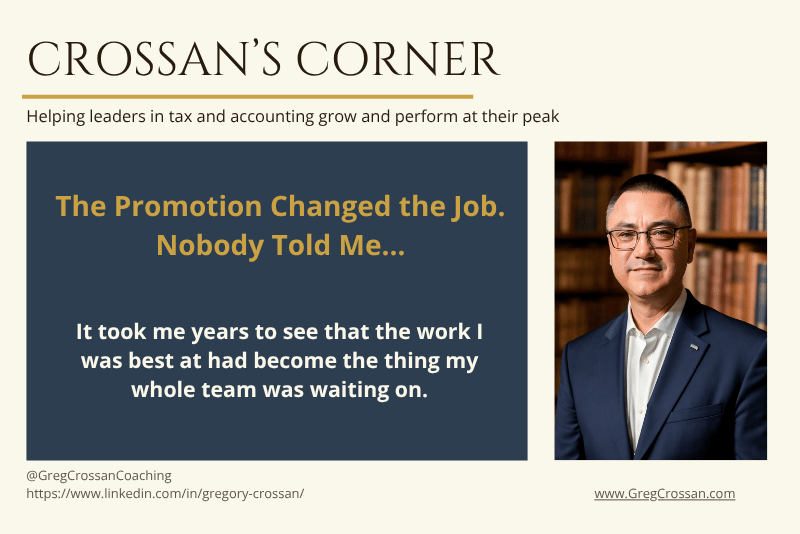
It took me years to see the work I was best at, had become the thing my whole team was waiting on.
I got promoted into leadership and spent the next few years quietly avoiding it.
Not on purpose. I avoided it by doing the work I was already good at. Provisions, memos, the hard positions nobody else wanted to take a view on. I reviewed the closest, I rewrote what came to me, I caught what would have gotten missed. And it felt like leading, because I was working harder than anyone and the work was good.
I knew the job had changed on paper. The title, the comp, more names under mine on the org chart. What took me longer was feeling it in how I spent my days. I was responsible for a group's work now, and I still reached for my own first, because that was the part I knew I could do well.
So I did what I was good at. My team executed what I decided, and they got fast and reliable at it. They did not get better at deciding, because I never let a real decision get far enough from me to be theirs. Every position of any weight came back to my desk. Every judgment call ran through my hours. And slowly, without noticing, I became the ceiling on everything the group could do.
Here is the part that took me years to say plainly. Some of it was standards. I held the work to a high bar and I am not sorry for that. Most of it was that being the person with the answer was where I felt safe. As long as the hardest call ran through me, I stayed necessary. And I never had to sit in the discomfort of watching someone else get it 80 percent right and learn from the other 20.
That is not a flattering thing to write, and it took me a while to be able to write it. It is also common. I have met enough senior tax and accounting leaders since to know the arrangement is almost standard equipment for people who were promoted on the strength of their technical work.
The seat needed two things I had never been taught, and the technical track had no reason to teach me.
The first was how to grow another person's judgment instead of substituting my own. That is a real skill and it is slow. It means letting a manager carry a position to a conclusion I can see is a little wrong, asking questions instead of fixing it, so that next time the reasoning is theirs and not something they borrowed from me. Every instinct I had built over 20 years told me to just fix it and move on. The deadline was real. The exposure was real. Fixing it myself was faster every single time... and every single time, it kept my team exactly where they already were.
The second was how to be measured by what my team produced when I was not in the room. For most of my career my value was legible. I did the analysis, the analysis was right, people could see it was right. Leadership does not work that way. The better I got at it, the less visible my own hand became, until on a good day the function ran well and none of it obviously traced back to me. I had to learn to be okay with that. It went against 30 years of how I understood my own worth at work.
The shift came slowly, and it came with help. What moved it was getting honest about what I was actually afraid of. That the team would find out I was not as far ahead of them as my title suggested. That if I was not the smartest person on the tax question, I was not sure what I was. Saying that out loud, to someone whose job was to sit with me in it and not rush me past it, did more for me than any tactic ever could.
The behavior changed once the fear had a name. I could hand a position to a manager and stay out of it, because I finally understood I was not handing away my worth. I could let the 80 percent stand and coach the 20, because I was no longer bracing to be found out. What had been in my way the whole time was the story I carried about what my competence was for.
This is most of what I do now. I sit with tax and accounting leaders who are strong at the work and stuck in the seat, while they get honest about what they are protecting. The tactics come easy after that.
If you are reading this from inside a promotion that made you responsible for a group, I want to save you a few of the years it cost me. Look hard at what still runs through you. Set aside the handful of things only you can legally sign. Everything else that keeps coming back to your desk, ask why. Some of it is habit. Some of it is that a part of you is not ready to find out what happens when you let it go.
The question I sit with now, on the other side of it, is a simple one to ask and a hard one to answer. What am I still holding onto because holding it is where I feel most sure of myself? I did not have a good answer the first time someone put it to me. It took a while. I think about it more now than anything technical I ever learned.